
Home page • Table of Contents • Send your writings and e-mail to: Editors@tanbou.
- In this issue:
- Presenting Gaze of Thunder
- L’écriture inclusive à l’épreuve de la linguistique
- Who We Art
- On the 2026 World Cup
- Jesse Jackson, yon towo pou dwa moun
- Homage to Two Poetic Titans
- Jesse Jackson, yon towo pou dwa moun
- Hommage à Anthony Phelps
- Hommage à Michèle Voltaire Marcelin
- Berny Jacques entre Fanon et la métaspora de Joël Des Rosiers
- Quand l’État stratège fusionne la défense, le capital-risque et l’intelligence artificielle
On the 2026 World Cup
—by Tontongi
I am one of the fortunate few who witnessed the Haiti’s opening match against Italy in Munich, West Germany, on June 15, 1974. A few friends of the neighborhood crowded the living room of Samuel, the owner of the local Pawn Shop, who was so kind to invite us to watch the game with him. The atmosphere was exciting, exhilarating. When Haitian player Manno Sanon scored a goal in the first minutes of the game against the legendary Italian goalkeeper Dino Zoff, the whole of Haiti felt suspended in both semi-consciousness and elation for a long, full minute
As we know, Haiti eventually lost the match to Italy 3 to 1, with goals by Gianni Rivera, Romeo Benetti and Pietro Anastasi. But for Haiti, losing or winning was not the point, not even the goal. It was the recognition of Haiti by a world for the modernity of which it had contributed so much, and for which it paid so high a price. We must remind the readers, that 1974 was only the third year of the 15-year dictatorship of Jean-Claude Duvalier —known outside as Baby who succeeded his father’s 14-year dictatorship. The Haitian delegation which traveled to Italy was packed with Tonton-Macoutes whose mission was to spy on the team members and keep them in check. There were reports of many abuses and aggressions perpetrated by those Tonton-Macoutes against the players and others.
Although I loved the game of football (watching and playing it myself was my preferred recreation during my youth), I wrote about it only once, in the context of the 2010 World Cup. Being a fan, like most Haitians, of the Brazilian national selection, I was upset that their coach at the time, CarloVerri (aka Dunga), didn’t call up Ronaldinho—at the time one of their best players
I criticized Dunga for letting his personal beef with Ronaldinho interfere with his important mission of securing a 6th World Cup for the Selaçao. Besides, I thought that his not choosing players like Ronaldinho and Adriano meant the coach decided in favor of a more rigid, defensive style of play, committing a sort of betrayal of theJogaBonito, the beautiful game, in which they excelled with so much artistry, athleticism, and sublimity. This characteristic style brought us pleasure, even pure happiness in our moments of direst challenges. I was convinced that the early departure of Brazil from the 2010 World Cup, at the quarterfinals stage, had something to do with that betrayal
In his book Soccer in Sun and Shadow (1995/1998), the Uruguayan journalist and novelist Eduardo Galeano explores all aspects of football, including goals by Pelé, Jairzinho and Maradona, and many styles of goals. The book has also a chapter on the Theater or theatricality of the game: ‘The payers in this show act with their legs for an audience of thousands of millions who watch from the stands of their livingroom with their souls on edge. Who writes the play—the manager? This play mocks the author, unfolding as it pleases and according to the actors’ abilities.’
Galeano defines the soccer fan as someone ‘in the madhouse. His mania for denying all evidence finally upended whatever once passed for his mind. And the remains of the shipwreck spin aimlessly in waters whipped by a fury that gives no quarter.’ The killing of Columbian player Andrés Escobar outside a nightclub in Medellin, Columbia, for having mistakenly favored an own-goal in the group stage match against the United States in the 1994 World Cup, was certainly one of those moments of madness
Galeano defines the soccer fan as someone ‘in the madhouse. His mania for denying all evidence finally upended whatever once passed for his mind. And the remains of the shipwreck spin aimlessly in waters whipped by a fury that gives no quarter.’ The killing of Columbian player Andrés Escobar outside a nightclub in Medellin, Columbia, for having mistakenly favored an own-goal in the group stage match against the United States in the 1994 World Cup, was certainly one of those moments of madness.
In his introduction to Soccer in Sun and Shadow, Rory Smith says that ‘Galeano saw decades in advance, precisely where soccer was heading. He had known that the defining tension in the game, the ultimate battle was not between the soccer of the left and of the right—as depicted by the great Argentine manager Cesar Luis Menotti—but between what he termed ‘heroic’ soccer and its mortal enemy, the system. Heroic soccer is designed by the idols on the field, by their virtuosity and their imagination. System soccer is designed and directed by coaches, bureaucrats and tailored suits and baggy leisurewear, drawing up schemes and plans on the sidelines.3
Galeano would not have been surprised by the cozy relationship between Donald Trump and FIFA’s president Gianni Infantino, he who knew the interconnection and connivance between big business, geopolitics and corruption
The World Cup is always an opportunity to bringing the world together, to reuniting other cultures which otherwise would hardly be together; it provides opportunities of encounters with Others . That’s one of the reasons it bothers me that FIFA—the World Cup’s international organizing institution—refuses to allow this year’s Haitian national team to wear the concept of the jersey they initially designed, under the pretext it was ‘too political.’ Why would a design theme that extols Haiti’s last victory battle against the French invaders in November 1803 be ‘too political?’ Is it not too political also that the Trump administration refuses entry to the US to thousands of Haitian soccer fans under the entry ban? The FIFA president doesn’t say anything about that
Soccer or football (as the rest of the world calls it) is the sport most accessible to the poor of multiple regions of the globe. You don’t need to have the means to afford an expensive racket, net or gloves. Not even a ball: in my youth we used worn-out socks and used clothes to make a ball, utilizing any playing space Mother Nature or urban contingence might offer us. One day, when a group of us decided to organize a soccer team in the Port-au-Prince neighborhood of Carrefour, we found a clever stratagem: we named the team officially ‘Veto,’ the name of the neighborhood convenience store. Proud of the recognition, the owner of the store bought us jerseys, and even socks
In reality, it wouldn’t cost FIFA too much to accept Haiti’s initial jersey proposal, when we think—by dialectical rapprochement of seemingly different categories and the ultimate positive consequences to both the emerging Haiti and the world—of the Battle of Vertières, in November 1803. The last one against the French, Napoleonic invaders, before Haiti declared independence in January 1804
In my poem ‘Haiti is Not What What You Say, Mr. Tèt Mato,’ directed at Donald Trump’s calling Haiti and the whole continent of Africa ‘shithole countries’ in 2018. I wanted to tell him, and all his MAGA fans and far-right supporters who despise Haiti, the other story of my country: its contribution to our modernity in prioritizing the inalienability of being, the radical emancipation from liberty itself, that defined the slave rebellions on the plantations of Saint-Domingue.
The final Battle of Vertières led to Haiti’s independence, which led to Haiti providing help and comfort to first Latin American rebel Francisco de Miranda in 1806, who was fighting against Spanish colonialism. It was in the port of Jacmel, in Haiti’s southwest, that Miranda conceived Venezuela’s first tricolor flag, its emblem of freedom
In December of 1815, it was the turn of Simon Bolívar to visit Haiti, under the presidency of Alexandre Pétion. After many defeats in his struggle against Spain’s rule in Latin America, Bolívar came to Haiti seeking protection and military aid. Pétion, possibly pleased of finding a cause that reaffirmed Haiti’s principles of liberation and international solidarity, provided to Bolívar most of the things he asked for: ships, weapons, troops, and food. The only condition? That Bolívar would abolish slavery in all the regions he liberated
May the reader permit me to quote a few lines of the poem that lists many of Haiti’s contributions to other nations’ struggles for liberation, and thus, the integrity and inalienability of being
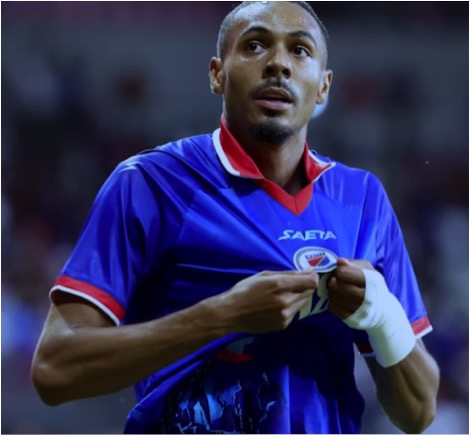
The FIFA banned Haiti’s original jersey, here worn by Haitian attacker Wilson Isidor. —photo Getty, Leonardo Fernandez
Haiti is the country that stood
to her own peril and harm
against almighty France,
Spain and England
over the inalienability of being.
Haiti is the foundation of our modernity,
Haiti is the unsung mother of Latin America;
Haiti is where Francisco de Miranda and Simon Bolívar
came to acquire the fervor of brotherhood
and resources to liberate their lands.
Haiti has made hers, heroic and brave
countless other countries’ causes
for human freedom and independence,
the most Hellenic nation of Greece among them.
{...] Haiti is among the richest countries in the world
by measure of intellectual and philosophical
achievement of her people’s genius
and for the beauty of this mountainous land
despite the human-made pollution aided and abetted
by U.S. support of corrupt dictators.
Haiti is not what you say, Mr. Tèt-Mato;
Haiti has sent to North America’s shores
thousands of doctors, researchers, intellectuals
and teachers who instill values
that enliven and enrich the children’s fortitude;
some of her migrants scrub your floors
and take care of your sick and feeble;
Haiti has been good to the United States2
In my upcoming book Le Regard de l’Autre (‘The Gaze of the Other’ (2026–27), I speak also of the false sublimity adopted by the Western power structure in relationship to sport and the acclaimed athletes
‘‘The white Establishment’s infatuation with the Black athletic hero, as seen in the most famous examples like Edson Arantes do Nascimento Pelé, Muhammad Ali, or Kobe Bryant, is always experienced as an extraordinary occurrence, a phenomenal, exceptional, even accidental event that simultaneously satisfies its fantasies of glory and its need for a self-satisfied sense of self-worth. It’s worth remarking that O.J. Simpson and Malcolm X came from the same historical, ethnic, and social background. However, while one was celebrated by the so-called mainstream—the socioeconomic and political Establishment—the other was perceived as its worst enemy. While one had imbued his soul with the soaring splendor of the American Dream, the other had ventured into the unknowns of political rebellion to demand justice for his country and freedom for his people. Still they are survivors of the same dysfunctional socioeconomic reality, viewed from different perspectives
[...] That one is assassinated as a martyr, and the other defamed as a villain, says a great deal about American spectacle culture. Yet their shared Blackness is a very small part, a mere referential epithet in the overall meaning of the tragedy. The undeniable truth is that the majority of the wretched of the earth—be they Black, white, Asian, or Native American—share the fundamental alienation of these two men’s destinies, through the constant intermingling of validation and valorization between success and failure, between representation and exclusion, between popularity and invisibility, between poverty and wealth, between necessity and contingence, fullness and incompleteness, being and nothingness.’ 3
Very fortunately—despite all of the dire occurrences and consequences of the struggle between what Galeano calls soccer’s system of management and control and its heroic idols, the players themselves; despite FIFA’s connivance with capitalism’s finality of profits at any price; despite all negative efforts to blemish the game and its supporters —, the organization of the 2026 World Cup in all three countries (US, Canada and Mexico) has been, so far at the group stage of the game, a relative success. The story of the Scottish soccer fans in Boston, at the Fenway Stadium, chanting North-American pop songs; the many reports by the foreign soccer fans themselves, praising the generosity of their North-American hosts, the human waves, the celebration of life and human connection and embrace at the stadiums, even within the context of sportive competition, have been a great source of joy and self-deplacement, of even happiness, for billions of us throughout the globe. It’s this little, magical, element of the World Cup we should all help preserve
—Tontongi Boston, June 24, 202
Notes
| 1. | Eduardo Galeano, Soccer in Sun and Shadow, Bold Type Books, 2013. Translated from the original Spanish by Marc Fried, with introduction by Rory Smith |
| 2. | The quotes and parts of the poem quoted are from my book Gaze Of Thunder, Trilingual Press, Boston, 2025. |
| 3. | Tontongi,Le Regard de l’Autre (‘The Gaze of the Other’), 2026–2027. |
Home Page • Table of Contents • Send your writings and your letters to: Editors@tanbou.com
- In this issue:
- Presenting Gaze of Thunder
- L’écriture inclusive à l’épreuve de la linguistique
- Who We Art
- On the 2026 World Cup
- Jesse Jackson, yon towo pou dwa moun
- Homage to Two Poetic Titans
- Jesse Jackson, yon towo pou dwa moun
- Hommage à Anthony Phelps
- Hommage à Michèle Voltaire Marcelin
- Berny Jacques entre Fanon et la métaspora de Joël Des Rosiers
- Quand l’État stratège fusionne la défense, le capital-risque et l’intelligence artificielle