
Hommage à Michèle Voltaire Marcelin (1955–2026), la voix rageuse de la poésie de conscience
—Tontongi pour Tanbou (9 mai 2026)
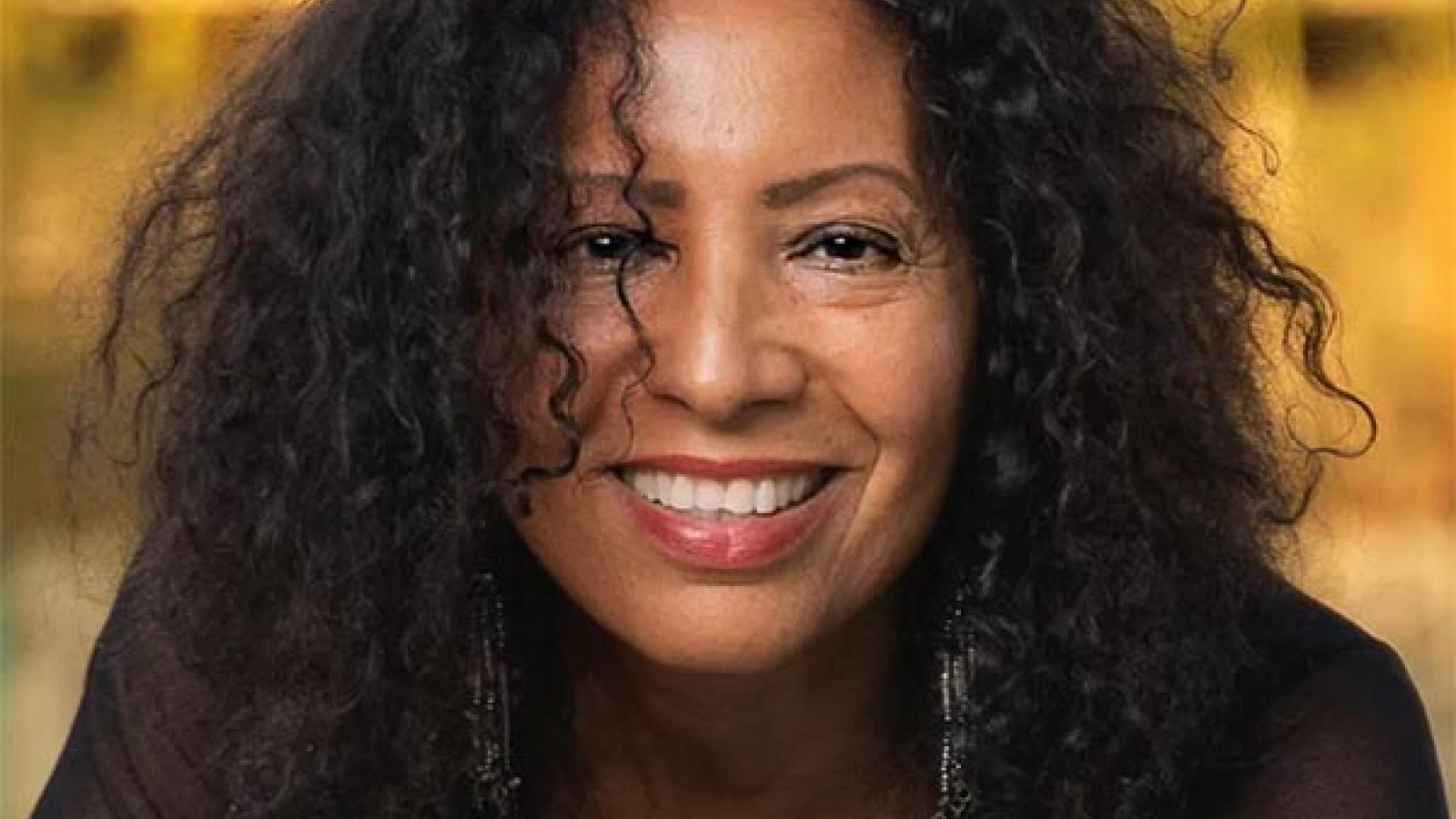
Michèle Voltaire Marcelin —photo credit: Repeating Islands
C’est avec une profonde tristesse que j’ai appris la nouvelle de la mort de la grande poète, artiste et actrice haïtienne, Michèle Voltaire Marcelin, survenue le 29 avril dernier. Elle a contribué à notre anthologie trilingue Cette terre, mon amour, publiée en 2023, nous prodiguant très généreusement des merveilles de ses talents et compétences artistiques, qui ont très enrichi l’anthologie. Bien que je l’aie rencontrée pour la première — et malheureusement dernière—fois durant la lecture à Brooklyn, NY, de l’anthologie organisée par Haiti Cultural Exchange en juin 2024, j’ai eu l’impression que nous avions été amis toute ma vie. J’aime sa poésie, elle semble être l’expression rageuse la plus authentique de la poésie de conscience. Son trépas constitue une grande perte à la poésie et à l’art haïtien en général. Toutes mes condoléances à son mari Jocelyn McCalla, à sa famille, et à ses amis et amies.
J’ai compilé plus bas quelques reproductions de citations d’hommages et de condoléances publiés dans les médias (sociaux et autres).
From Jocelyn McCalla’s Post on Facebook on April 30, 2026
Professor Sophie Mariñez wrote a biography of Michèle Voltaire Marcelin which was published in the Oxford Dictionary of Caribbean and Afro-Latin American Biography. The biography was published in 2016, thus it lacks the year of death, 2026. Please use this biography as reference, even though it does not account for the last 10 years. We will supplement the information soon.
Marcelin, Michèle Voltaire (1955– ), performer, writer, visual artist, and poet, was born Michèle Voltaire in Port-au-Prince, Haiti. Details about her parents are scarce, but stifled by the middle-class conformity of her family and social circle, she left Haiti in 1971 for Santiago, Chile, to join her brother Frantz Voltaire, a university student and teacher.
Michèle attended public school in Santiago until the 1973 coup d’état against the left wing government of Salvador Allende brought her new start to a quick, violent end. Military police raided the Voltaire home in search of incriminating evidence and found several of their friends who had decided to spend the night with the family. Deciding all were part of a conspiracy, the police arrested them, placing them in a van headed toward Chile’s national soccer stadium, which would become an infamous site at which many alleged dissidents were tortured and executed. Released three days later, she moved to New York, where she would later begin her literary and artistic career.
Voltaire Marcelin earned a B.F.A. from the Leonard Davis Center for the Performing Arts at the City University of New York and a M.S. from the New School for Social Research. She staged Walking on Fire, a monologue performed at the Alliance of Resident heaters, based on Beverley Bell’s stories of survival and resistance of Haitian women. She performed the role of “Marie-Ange” in Simone Schwarz-Bart’s play Ton Beau Capitaine, directed by Françoise Kourilsky, at the Ubu Repertory theatre. She also performed in The Vagina Monologues, directed by Chuck Patterson, at the Brooklyn Museum. In February 2009 she played the role of the “Republic of Haiti” in Entrées et Sorties by Carmelle St. Gérard-Lopez at the Producer’s theater in New York City. Other credits include William Saroyan’s the Time of Your Life, staged by Robert Macbeth and Israel Washington, and Van Italie’s Comings and Goings, directed by Rhea Gaisner.
In film, she worked with Haitian directors, notably Raoul Peck in Haitian Corner (1988) and the Man on the Shore (1993), which examined Haiti’s dictatorial Duvalier regimes. She also appeared in Patricia Benoit’s Se Met Ko (1989), a film dealing with AIDS in the Haitian community and Benoit’s Stones in the Sun, a film about Haitian exiles in New York, also starring the writer Edwige Danticat, that premiered at the 2012 Tribeca Film Festival.
Voltaire Marcelin writes in French, English, Haitian Creole, and Spanish. Her first novel La Désenchantée (2006), and its Spanish version La Desencantada, received wide critical acclaim. Set under the François “Papa Doc” Duvalier dictatorship (1957–1971), the novel delves into the narrator’s past, exploring a family universe dominated by strong characters and affected by the cruelty, violence, and despair of the time. Marked by the narrator’s particularly poetic voice, the text honors all-time favorite authors with quotes from Antoine de Saint-Exupéry, Guillaume Apollinaire, Paul Éluard, Jack Kerouac, Simone Weil, and Charles Baudelaire, among others, that emphasize the lyrical and emotional import of the story. La Désenchantée was soon followed by two books of poetry: Lost and Found and Amours et Bagatelles (2009), the latter of which was translated into Spanish as Amores y cosas sin importancia (2009).
Voltaire Marcelin’s work has been included in diverse anthologies published in France, Canada, and the United States, including Terre de Femmes (2010), a special issue on Haiti for Cahiers de la Revue d’Art, Littérature, Musique (2009), Revue Intranqu’îllités (Vols. 1 and 2, 2011–2013), Anthologie Secrète de Magloire Saint-Aude (2012), and Haïti Noir 2, the Classics (2014). [Including Cette terre, mon amour / Tè mwen renmen an / This Land, My Beloved, Boston, Trilingual Press, 2023.]
Voltaire Marcelin has read and performed her poetry at numerous national and international venues, including the Brooklyn Museum, Museum of Contemporary African Diasporan Arts (MoCADA), La MaMa Experimental theatre Club, Cornelia Street Café, New Morning jazz club in Paris, Lion d’Or Cabaret in Montreal, the United Nations, and international book fairs in Miami and Costa Rica. She has also presented her work in academic venues, such as Vassar College, the Segal theater at the Graduate Center of the City University of New York, and UCLA’s Fowler Museum, during the Haiti Stories/ Istwa Ayiti conference.
As a visual artist, Voltaire Marcelin has exhibited her works at the Art Museum of the Americas (overseen by the Organization of American States, OAS) in Washington, D.C.; Cork Gallery in Lincoln Center and Broome Street Gallery in New York City; the African-American Museum in Hemp-stead, Long Island; and the Museum of National Patrimony in Haiti.
[See also Danticat, Edwidge; Duvalier, François; Duvalier, Jean-Claude; Peck, Raoul; and Schwarz-Bart, Simone.]
Bibliography
Michèle Voltaire Marcelin (website). http://www.lidous.net.
Trouillot, Lyonel. “L’univers domestique haïtien: Souvenirs de la cruauté; Critique littéraire de ‘La Désenchantée.’ ” Le Matin, no. 32701, 15 January 2007.
Voltaire Marcelin, Michèle. Amores y cosas sin importancia. Havana, Cuba: Editorial ALBA, 2009.
Voltaire Marcelin, Michèle. Amours et Bagatelles. Montreal: Éditions du CIDIHCA, 2009.
Voltaire Marcelin, Michèle. La Désenchantée. Montreal: Éditions du CIDIHCA, 2006.
Voltaire Marcelin, Michèle. Lost and Found. Montreal: Éditions du CIDIHCA, 2009.
Voltaire Marcelin, Michèle. “True Life.” In Haïti Noir 2, the Classics, Part 2: Seduced, edited by Edwidge Danticat, pp. 176–186. Brooklyn, N.Y.: Akashic, 2014. Originally published 2008. Sophie Maríñez
Réaction
Le linguiste-terminologiste Robert Berrouët-Oriol> a dit que « L’annonce du décès de Michèle Voltaire Marcelin, poétesse, peintre, romancière et comédienne, a fait l’effet d’un tsunami : la sachant malade, ses amis, ses parents, ses proches s’y attendaient, tous habités par l’effroi, le cœur transi de chagrin… Mais lorsque la Grande Faucheuse frappe à la porte, nous voici mutiques, la parole en berne, nous voici claudiquant sur l’archipel des gestes désormais orphelins… »
[Facebook/ Madinin’Art post « Pour saluer la mémoire de Michèle Voltaire Marcelin, poétesse, peintre, romancière et comédienne ».]
Parlant dans un précédent text du livre de MVM, Clair/Obscur - Depth/Glow,
Berrouët-Oriol remarque en particulier son « architecture bilangue » :
« Michèle Voltaire Marcelin élabore son œuvre poétique en français, sa langue maternelle, et en anglais des États-Unis, langue usuelle du pays où elle a émigré. Le livre s’ouvre par l’inscription d’un énoncé-incipit bilangue, « La lumière n’est pas l’opposé de l’ombre, mais son autre nom » / « Light is not the opposite of darkness, but its other name » (page 7). Cet énoncé-incipit bilangue porte haut la double articulation du dispositif scriptural de l’œuvre, à savoir l’appariement de l’ombre et de la lumière. Ainsi s’énonce le bilangue « Prélude / Prelude », qui circonscrit le projet tout entier de l’œuvre : « Chaque poème commence dans l’ombre. Chaque poème commence dans la lumière. Nous avançons entre les deux, portant des noms, des blessures, des chants. Des fragments du labyrinthe nous accompagnent : l’histoire, le corps, le feu, la mer. Certaines nuits, quelque chose en nous se relève –une étincelle, un fil, un souffle qui refuse de céder. Ce livre est un souffle » (page 8).
Le dispositif bilangue du livre—l’ordre d’apparition consécutif des poèmes : la version française précède la version anglaise–, s’apparente à celui d’une concaténation—au sens de « la juxtaposition, de l’enchaînement d’unités linguistiques dans un ordre donné », assurant ainsi les parcours et l’ancrage du couple ombre/lumière. En effet l’architecture générale de « Clair/Obscur—Depth/Glow » est bien celui d’une concaténation scripturale ancrée dans un mouvement en quatre temps :
- « Témoigner / Witnessing » : « Témoigner est le premier feu / Witnessing is the first fire » ; suivi en versions française et anglaise du titre des « 9 poèmes de témoignage, de seuils, de mémoire vive » (page 9).
- « Les profondeurs / Depth » : « Ce qui nous hante vit sous la surface / What haunts us lives beneath surface » ; suivi en versions française et anglaise du titre des « 8 poèmes d’histoire, d’héritage, de retours impossibles » auxquels s’ajoutent la déclinaison des poèmes bilangues français-anglais numérotés 10 à 17 (page 10).
- « Amour et défaillance / Love and loss » : « Le cœur se brise, s’ouvre, s’éclaire –et recommence », suivi de « 9 poèmes du corps et du cœur, du désir, des blessures intérieures » auxquels s’ajoutent la déclinaison des poèmes bilangues français-anglais numérotés de 18 à 26 (page 11).
- « Lumière / Light » : « Chaque aube est une frontière traversée » suivi en versions française et anglaise du titre des « 9 poèmes de recommencement, de transmission, de grâce, de survivance » auxquels s’ajoutent la déclinaison des poèmes bilangues français-anglais numérotés de 27 à 35.
La concaténation scripturale ancrée dans le mouvement en quatre temps constitue l’architecture même de « Clair/Obscur—Depth/Glow » : c’est sur le registre d’une fiction poétique singulière et hautement maîtrisée que le livre est formellement structuré, c’est très précisément dans ce mouvement en quatre temps que l’œuvre est construite et trouve sa cohérence à la fois thématique et ordonnancée. Ainsi se donne à voir en cohérence « Le premier feu », la parole inaugurale de laquelle procèderont toutes autres paroles, car il s’agit pour l’auteure de « Témoigner », de passer de la lumière à l’obscur et de l’obscur à la lumière. »
[Citations tirées du texte de RBO « Michèle Voltaire Marcelin, tisserande d’une œuvre poétique polyvocale et forte en ses registres de lumière » Facebook/ Madinin’Art post « Pour saluer la mémoire de Michèle Voltaire Marcelin, poétesse, peintre, romancière et comédienne ». ]
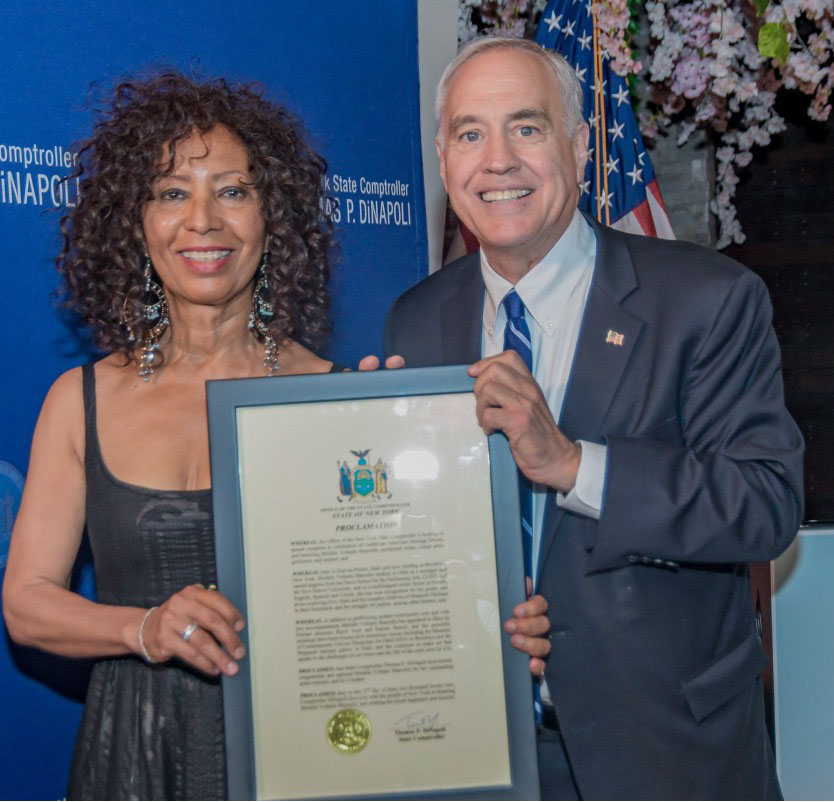
Michèle Voltaire Marcelin with NY State Comptroller Thomas Peter Dinapoli.
Statement of NY State Comptroller Dinapoli on the passing of Michèle Voltaire Marcelin: “We lost a wonderful poet, artist and advocate. Michele Voltaire Marcelin used her words and her art to lift us up, and even through her battle with cancer, never stopped living life to its fullest. She stood for freedom and justice for her fellow Haitians and for all people. I was honored to recognize her in 2022 during our Caribbean Heritage celebration. My condolences to @leo.coltrane, Jocelyn, and her family and friends.”
Haitian Times
Community mourns Michèle Voltaire Marcelin, Haitian poet, writer and performing artist [Extraits du Times du 8 mai, 2026]
Michèle Voltaire Marcelin, the Haitian multi-disciplinary artist whose work explored exile, dictatorship, womanhood and Haitian identity across several decades, died April 29 at age 70. Her influential body of work spans literature, theater, film and visual arts, and she performed and exhibited internationally while remaining deeply connected to Haiti’s cultural memory.
NEW YORK—Michèle Voltaire Marcelin, the Haitian writer, actress and visual artist known for works that explore exile, dictatorship and Haitian identity across disciplines, died April 29 at age 70. Through her poetry, novels, performances and films, Voltaire Marcelin became known over several decades for telling stories about exile, survival and the emotional weight of various traumas she experienced.
Her death, announced by her husband Jocelyn McCalla via Facebook, has prompted an outpouring of tributes across communities in Haiti, New York, Montreal, Paris—among numerous diasporic locales she touched. In sending condolences to McCalla, the community organizer and activist, and Voltaire Marcelin’s son, Leo Coltrane, many mourners recalled a powerfully fierce voice who carried her native country’s stories across borders and eras.
“Sleep well, Wondrous Woman! Rest in peace,” author Katia D. Ulysse wrote on Facebook in tribute.
It’s been days, Michèle Voltaire Marcelin. Words still fail me,” she continued. “How brave you proved to be! A veritable warrior.”
Monique Clesca, a journalist and activist posted the last message the two shared in her tribute.
“When a maple tree falls, you must be able to do like a goat to eat its leaves—I’m doing that with Michele, the big maple tree that fell,” she wrote “Thank you Michele, rude woman, brave woman of Haiti!”
Among civic and cultural groups, the Haitian Roundtable remembered her as “a visionary artist, poet, actress, and cherished member” of the Haitian community. It highlighted her role as an 1804 List inductee whose work helped broaden appreciation for Haitian culture, art and storytelling across generations.
“Her legacy lives on through the lives she touched, the art she created, and the cultural path she helped shape.”
[...] Professor Sophie Mariñez wrote in the Oxford Dictionary of Caribbean and Afro-Latin American Biography that Voltaire Marcelin’s life changed dramatically after the 1973 military coup in Chile, where her family originally lived. That year, Chilean military police raided the family home, arrested many, including the teenage Michèle, and took them in a van to the national stadium.
Released three days later, she fled to New York, where she would begin building her artistic and literary career. The stadium later became known as a detention and torture site under the Chilean dictatorship.
Mariñez described Voltaire Marcelin’s writing as deeply poetic while also confronting violence, fear and memory under dictatorship. Her literary work moved fluidly between French, Haitian Creole, English and Spanish.
Voltaire Marcelin’s 2006 novel La Désenchantée, set during François Duvalier’s rule in Haiti, became one of her best-known works around the globe. However, her early works of poetry helped establish Voltaire Marcelin as a bold, sensual artist whose observations touched on all aspects of living and loving—including the pain of losing her first husband, Ernst C. Marcelin, to gun violence in 1990.
“It’s a great loss for the community because Michèle loved Haiti and everything about Haiti,” said longtime fan Yolette Williams, executive director of Haitian American Alliance of New York. “She had a joie de vivre attitude that made people feel welcome around her.”
Williams recalled many fun cultural gatherings where Voltaire Marcelin recited poetry alongside saxophonist Buyu Ambroise. Whether centered on Haiti’s struggles, protest, love or sensuality, her poems transported her audience.
“She pulled you into the moment with her,” Williams said. “You could visualize every sensual word she said and feel that she brings you with her in that scene.”
Carrying the torch with new genres and generations
Over the years, Voltaire Marcelin took up a variety of genres to express her creativity, including painting, acting and performing about an array of topics.
She performed in productions including “Walking on Fire,” based on stories of Haitian women’s resistance collected by activist Beverley Bell, and appeared in “The Vagina Monologues” at the Brooklyn Museum. Voltaire Marcelin also acted in films by acclaimed Haitian director Raoul Peck, including “Haitian Corner” and “The Man by the Shore,” both centered on the trauma of Haiti’s dictatorship years.
Most recently, she emerged as a sought-after mentor and supporter of many programs to preserve and share Haitian culture, including the CUNY Haitian Studies Institute (HSI) and Haiti Cultural Exchange. In Haitian enclaves and far beyond them, she gave glimpses via social media of her life as an artist, embracing and being embraced by others in different scenes and settings—and in her everyday life.
“Michelle lived a full life,” HSI’s Executive Director Marie Lily Cerat. “She contributed so much to the building of this community, artistically speaking. Whenever you needed Michèle, she was ever present to give what she could give to make the community look good.”
Voltaire Marcelin and Leo Coltrane were often paired together for storytelling workshops that HSI organized as part of its Ayiti in the City summer program for youth. “She’ll be sorely missed, she’s been a collaborator for many years,’ Cerat. “But I know her spirit will continue to inspire others, in the youth in the “Ayiti in the City,” the ones she worked with to share techniques and tools for storytelling—that is part of her legacy.
“That’s her living art,” Cerat said.
Michèle Voltaire Marcelin’s funeral services took place on Saturday, May 9, in Brooklyn, with a church service at the Church of St. Jerome, 2900 Newkirk Ave., followed by a tribute at the William Jennings Gallery at Kenkeleba, where Voltaire Marcelin’s latest works are on exhibition with three other women artists, on Manhattan’s Lower East Side.
The first five comments on Jocelyn McCalla’s Facebook page illustrate the deepness of sorrow Michele Voltaire Marcelin’s death has befell on our communities:
Chè Jocelyn,
Sa fè mal tande nouèl tris sa a. Pasaj Michèle se yon grann pèt pou kominote nou an. Erezman, kouwè Michèle te di lè m te mande l pou l kòmante sou lanmò yon lòt gran powèt nou, Danielle Legros Georges: “Thankfully she leaves us poetry, which is eternal.”(“Erezman li kite pwezI pou nou, kI limenm etènèl”. Kenbe kouraj Jocelyn, rejwI w de tan bèl tI memwa ak souvans ou pataje ak Michèle yo. Mwenmenm ak madan m mwen voye tout kondoleyans nou pou ou, pou fanmI ak zanmI Mihèlle Voltaire Marcelin, yon michan imanis.
Kondoleyans Jocelyn, pou ou ak tout moun nan lakou Michèle, tokay mwen. Sa se nouvèl kè kase. Mapou sa a gen rasin ki pwofon e kin anpil—rasin sa yo travèse nanm nou.
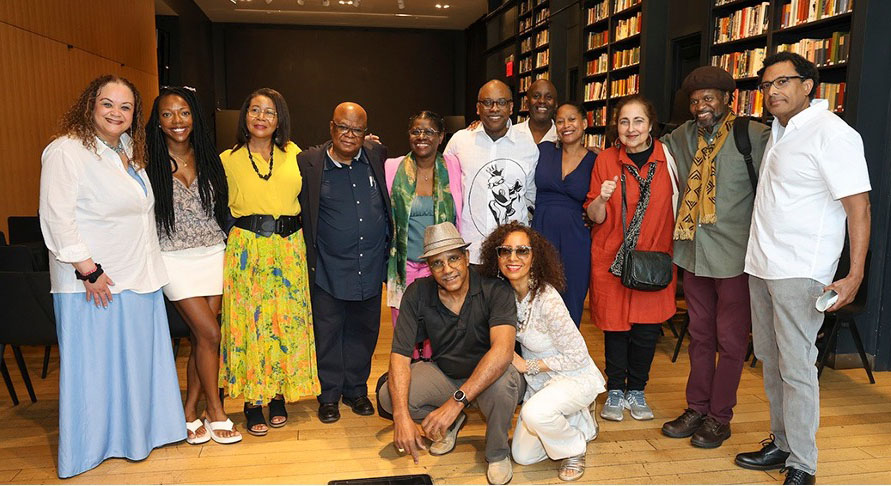
Michèle Voltaire Marcelin (milieu avec son mari Jocelyn McCalla) lors de la lecture à Brooklyn, NY, de l’anthologie trilingue Cette terre, mon amour organisée par Haiti Cultural Exchange en juin 2024.
I am so very sorry to hear of her passing. I feel so heartbroken. She was such a light in my life. May her soul continue to live on with just as much light, zest, love and joy.
Kondoleyans! Se yon kou siprann pou anpil nan nou. Pran kouraj, zanmi.
On no is it true what I am reading. Our beautiful multi-talented Haitian artist, scholar passed away. I am deeply sorry for the lost of your beautiful wife, your great soulemate, the amazing mother of great multi talented son artist Léo Coltrane Marcelin. My Condoléances to you, Léo, her family and friends and I also . I called her my beautiful nature sister artist friend. Va En Paix la belle multi talentueuse Michèle dans l’eau delà. On ne t’oubliera jamais, tes grandes oeuvres, ton sourire resteront avec nous pour toujours. I have so many of your books at my house. I am glad and fortunate to meet you. You are one of my inspirational people. Courage et force à toi Jocelyn Léo Coltrane, toute la famille de Michèle et amis.